Visual LINQ Query Builder - VS 2008 Add-In

Visual LINQ Query Builder - VS 2008 Add-In

Visual Linq Query Builder helps you create Linq to SQL queries for your programs(Support for C# and VB projects is provided) and demonstrates how to create their own Visual Studio 2008 add-in by using WPF.

Here are some screenshots of Visual Linq Query Builder in designer mode

clip_image016_2

clip_image018_2

Download Visual LINQ Query Builder and documentation

Web 3.0 | PERSONALIZE MEDIA

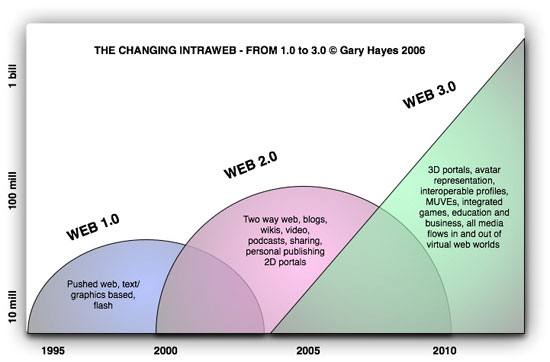
I have posted prolifically about MUVE’S (Multi User Virtual Environments) in the past, concentrating mainly on the ever customisable Second Life. It is interesting to watch the buzz spreading and consider if virtual worlds are really web 3.0, I think so. A quick look at the evolution of the intraweb from the mid 90′s. From text and graphics dominate 2D environments, immersive web sites with flash quickly followed combined with ubiquitous communication via IM and IRC chat. Then the early 00′s with the expontential growth of self publishing, blogs and wikis. From 2002 onwards the massive sharing social network communities of flickr and YouTube in sync with the explosion of portals containing all of the above in services such as MySpace, Yahoo and MSN etc: We are heading towards a rich media personal hub that points to and houses all of our ‘shareable’ content. But the current 2D web, mostly linear to linear linking, is about to be enhanced by virtual environments in which we meet as avatars, interact as 3D moving objects that takes sharing, co-creation and communication to the next, predictable level. The important component here is real time collaboration and communication as the paradigm shift.
Web 1.0 to 3.0

Web X.0. To me evolution of the web can be defined in single sentences:

    1.0 the pushed, one way only web
    2.0 the two-way shared web
    3.0 the real time collaborative web (3D, isometric or just 2D)

A sign that this is reaching a level of maturity is when big brands and subscriber numbers start to escalate. This item entitled Second Life Targets Existing Branded Web Communities succinctly sums up some of the major changes in one MUVE.

Major companies such as Major League Baseball, and institutions such as The University of Southern California, have already turned to to host synched with live real-world events. Organizations such as the New Media Consortium are using to convene meetings and conferences. Wells Fargo is teaching kids about finance in an engaging manner through . Clothing designers are using the community to prototype their designs and get community feedback and build buzz before they have to manufacture.

In 2 years time will the most effective way of communicating be through a variety of MUVEs rather than 2D web? As subscribers go above half a million, from less than 100 thousand less than 6 months ago one can see other players beside taking part of the action. Here are the stats from yesterday to give some idea of the scale

Statistics from 3:20pm Saturday 26 Aug 2006
Total Residents: 568,856
Logged In Last 60 Days: 256,425
Online Now: 8,369
US$ Spent Last 24 Hrs: 357,140

Many of the projects we are doing in LAMP start from a position of ‘experience design’ that has its ultimate incarnation in letting the users ‘live’ the story. Personalizable MUVE’s will shortly have real potential to enable any experience requirement you can throw at it. As the gaming generation take up lead roles in society (the average age of a Second Lifer is 32) I really believe that remote communication will exist more and more in virtual worlds. Entertainment, education and business is already taking root. The article continues by even pointing to the political engagement these environments afford…

Imagine a wiki-based web community now being able to collaboratively design detailed 3-dimensional objects, complete with nuanced permissions, instead of just text documents. …Imagine a dark horse political candidate with a virtual campaign headquarters in which campaign volunteers can collaborate regardless of geographic location and be trained personally by the avatars of real campaign staff, and where the candidate can conduct a virtual whistlestop tour to test new stump speeches and conversations with highly educated, affluent, and socially networked focus groups

Current MUVE’s do require decent computers, graphics and bandwidth but many millions of terminals are already capable. There are many posts that talk about a ten year from now predication of what a Virtual World may be, many not looking too deeply into the ethical or moral issues as that really is an unknown as this quickly cobbled together chart above suggests I think we are lucky to be at the dawning of ubiquitous MUVE’s across all devices (mobile devices are part of distribution in this context – not a movement in itself). The next challenge as I always point out is interoperability – how our personalized digital fingerprint can exist across an ever growing range of portals. To put it another way using the present day, can out MySpace profile work with our avatar, our flickr and YouTube accounts. Will our eBay positive rating be carried into World of Warcraft, can Amazon engines learn what we are buying in to recommend things to buy from eBay and so on. The brand and advertising targeting potential goes off the scale here. The first company that comes up with a profile engine that combines all of the above, sits above them, cross-relates them but needs to get started right now before it becomes way too complicated ;-)

reference : http://www.personalizemedia.com/articles/web-30/

Comparison .net framework 2.0-3.5-4.0

--------------------------------------------------------------------------
NET framework 2.0:
--------------------------------------------------------------------------
2.0 = Framework that shipped with VS 2005 VB 8.0 / C# 2.0

It involves

1) Generics
2) Anonymous methods
3) Partial class
4) Nullable type
5) The new API gives a fine grain control on the behavior of the runtime with regards to multithreading, memory allocation, assembly loading and more
5) Full 64-bit support for both the x64 and the IA64 hardware platforms
6) New personalization features for ASP.NET, such as support for themes, skins and web parts.
7) .NET Micro Framework
8) Language support for Generics built directly into the .NET CLR.
9) Many additional and improved ASP.NET web controls.
10) New data controls with declarative data binding.

--------------------------------------------------------------------------
.NET framework 3.0:
--------------------------------------------------------------------------
3.0 = Framework as 2.0 + WCF + WPF + WF

1) It is called as WinFX, includes a new set of managed code APIs that are an integral part of Windows Vista and Windows Server 2008 operating systems and provides
2) Windows Communication Foundation (WCF), formerly called Indigo; a service-oriented messaging system which allows programs to interoperate locally or remotely similar to web services.
3) Windows Presentation Foundation (WPF), formerly called Avalon; a new user interface subsystem and API based on XML and vector graphics, which uses 3D computer graphics hardware and Direct3D technologies.
4) Windows Workflow Foundation (WF) allows for building of task automation and integrated transactions using workflows.
5) Windows CardSpace, formerly called InfoCard; a software component which securely stores a person's digital identities and provides a unified interface for choosing the identity for a particular transaction, such as logging in to a website

--------------------------------------------------------------------------
.NET framework 3.5:
--------------------------------------------------------------------------

3.5 = all the above + LINQ technologies and will ship with the next VS including VB 9.0 and C# 3.0

1) 3.5 will be shipped with the next Visual Studio and the most dominant change is the addition of LINQ (language integrated query) technologies. There will also be new framework classes (for example, new encryption classes designed to utilize CNG). The languages themselves will probably have more significant changes than the framework.
2) It implements Linq evolution in language. So we have the following evolution in class:
a) Linq for SQL, XML, Dataset, Object
b) Addin system
c) p2p base class
d) Active directory
3) ASP.NET Ajax
4) Anonymous types with static type inference
5) Paging support for ADO.NET
6) ADO.NET synchronization API to synchronize local caches and server side datastores
7) Asynchronous network I/O API
8) Support for HTTP pipelining and syndication feeds.
9) New System.CodeDom namespace.

reference: http://www.dotnetspider.com

Top 10 List of SEO

Top 10 List of SEO

I think it is possible to list the most important elements in optimizing a web page (or web site for that matter) for search engines. Here are my top 10. Feel free to list yours or correct mine. They are not in order from most important to least important.

Top 10 Tips to SEO

1. Find out what keywords from your service and industry web site visitors are using in the search engines. If you manufacture blue, red and green widgets, find out if people are searching with those terms or if they are using big, medium and little widgets instead.

2. Optimize your web site’s Title tags. These are HTML scripted tags that appear in between the open HEAD and closing HEAD tags on your web page. Place your researched keywords in these Title tags because search engines count that tag as one of the most important on-page factors in ranking your page for the keywords it is optimized for. The Title tag is predominantly displayed in search engine results; is the first line of the result and is usually the link to your web page.

3. Optimize your web site’s Meta description tags. These also are HTML scripted tags that appear in between the open HEAD and closing HEAD tags on your web page. The Meta description tag is often shown in search engine results as one or two sentences that briefly explain what the web page is about. Place your page’s keywords in the description tag and write it as a grammatically correct sentence so searchers can get an idea of your page’s content.

4. Optimize your web site’s Meta keywords tags. These fit in between your web page’s open HEAD and closing HEAD tags on your web page. Many web page optimizers say this tag can be left out because the search engines no longer take it into consideration due to past spamming techniques that abused this tag. Directory managers, however, can use the keywords Meta tag to help place your web site in their directory.

5. When creating a web page for the first time, utilize one of the most important keywords or phrase for the page name. You will know what keywords are important for the page’s content through the research you conducted when you performed #1 above. If you are using more than one keyword, separate the words with a hyphen (dash) and use no more than three keywords for the name of the page. See an example in #6 below.

6. When creating a sub-folder in your web site, use a keyword or phrase in naming the folder. For example, if you sell widgets and you have pages on red widgets in a different folder than pages on blue widgets you might want the names of the folders to match the names of the pages. It would look something like this for a business web site named Widgets For All: www.widgetsforall.com/common-widgets/small-red-widgets.html.

7. Take advantage of the alt image attribute in HTML scripting. The ‘alt’ term stands for ‘alternate’ and was originally built into HTML scripting so that persons who didn’t want their browsers to display graphics could get a description of the image instead, hence ‘alt’. Search engines read the attribute (also known as the alt tag) and it is appropriate to place a keyword or phrase in the attribute. Don’t stuff it, use no more than five words if possible and have it make sense.

8. Make sure your web pages load quickly. While many people in the United States have high-speed Internet connections, search engine spiders (also known as robots) take into consideration the page’s size in kilobytes. If it takes a long time for your web page to load, the search engine’s spider will not travel through it (known as spidering a page or web site) and then your page will not rank for the keywords it has been optimized for. In addition, web pages that take a long time to load will probably not have many human viewers. There are too many other pages available on the World Wide Web for someone to wait during the time it takes for yours to load.

9. Make a plan to get links from web sites that carry authority in the search engines. These are established web sites that have been around quite awhile and have many web sites linking to them. A good example is MSN’s home page or Adobe’s home page. While it would be extremely difficult to receive a link from them, they carry the weight and have been established long enough to represent those kinds of web sites to seek out for an inbound link.

10. Have web sites that are linking to yours use your keywords in their links. Using the widgets example above, ask the web site owner you seek a link from to use something like this: A good source for red widgets is Widgets For All. The words,’ red widgets’ in the previous sentence would be the link that points to www.yoursite.com/common-widgets/small-red-widgets.html.

reference: http://www.submitawebsite.com/blog/2006/10/top-10-list-of-seo.html

SQL SERVER - 2005 - Generate Script with Data from Database - Database Publishing Wizard

SQL SERVER – 2005 – Generate Script with Data from Database -Database Publishing Wizard

I really enjoyed writing about SQL SERVER – 2005 – Create Script to Copy Database Schema and All The Objects- Stored Procedure, Functions, Triggers, Tables, Views, Constraints and All Other Database Objects. Since then, I have received questions about how to copy data as well along with schema. The answer to this is Database Publishing Wizard. This wizard is very flexible and works with modes like schema only, data only or both. It generates a single SQL script file which can be used to recreate the contents of a database by manually executing the script on a target server.

The pre-requisite for Database Publishing Wizard is .NET 2.0 Framework, SQL Server 2005 Management Objects, SMO. The Database Publishing Wizard will script all objects that the supplied User has permissions to see in the source database. Any objects created “WITH ENCRYPTION” cannot be scripted. If such objects exist in the source database, the tool will not produce a script. First of all, install Database Publishing Wizard: Download Database Publishing Wizard.

It will be installed at the following location:
C:\Program Files\Microsoft SQL Server\90\Tools\Publishing\.

Now login using Command prompt and run the following command on any desired database. It will create the script at your specified location. The script will have schema as well as data which can be used to create the same information on the new server.
Command to run which will create schema and database:

C:\Program Files\Microsoft SQL Server\90\Tools\Publishing\sqlpubwiz
script -d AdventureWorks “C:\AdventureWorks.sql”
Command to run which will create schema:

C:\Program Files\Microsoft SQL Server\90\Tools\Publishing\sqlpubwiz
script -d AdventureWorks “C:\AdventureWorks.sql” -schemaonly
Command to run which will create data:

C:\Program Files\Microsoft SQL Server\90\Tools\Publishing\sqlpubwiz
script -d AdventureWorks “C:\AdventureWorks.sql” -dataonly
Command Windows will generate output of action it is taking.

If you have followed this tutorial exactly, you will end up with adventurework.sql which will be quite big and if your computer is not powerful enough, it will hang your computer for a while. I suggest that you try this on a smaller database of a size of around 100MB.

Reference: Pinal Dave (http://www.SQLAuthority.com), Database Publishing Wizard